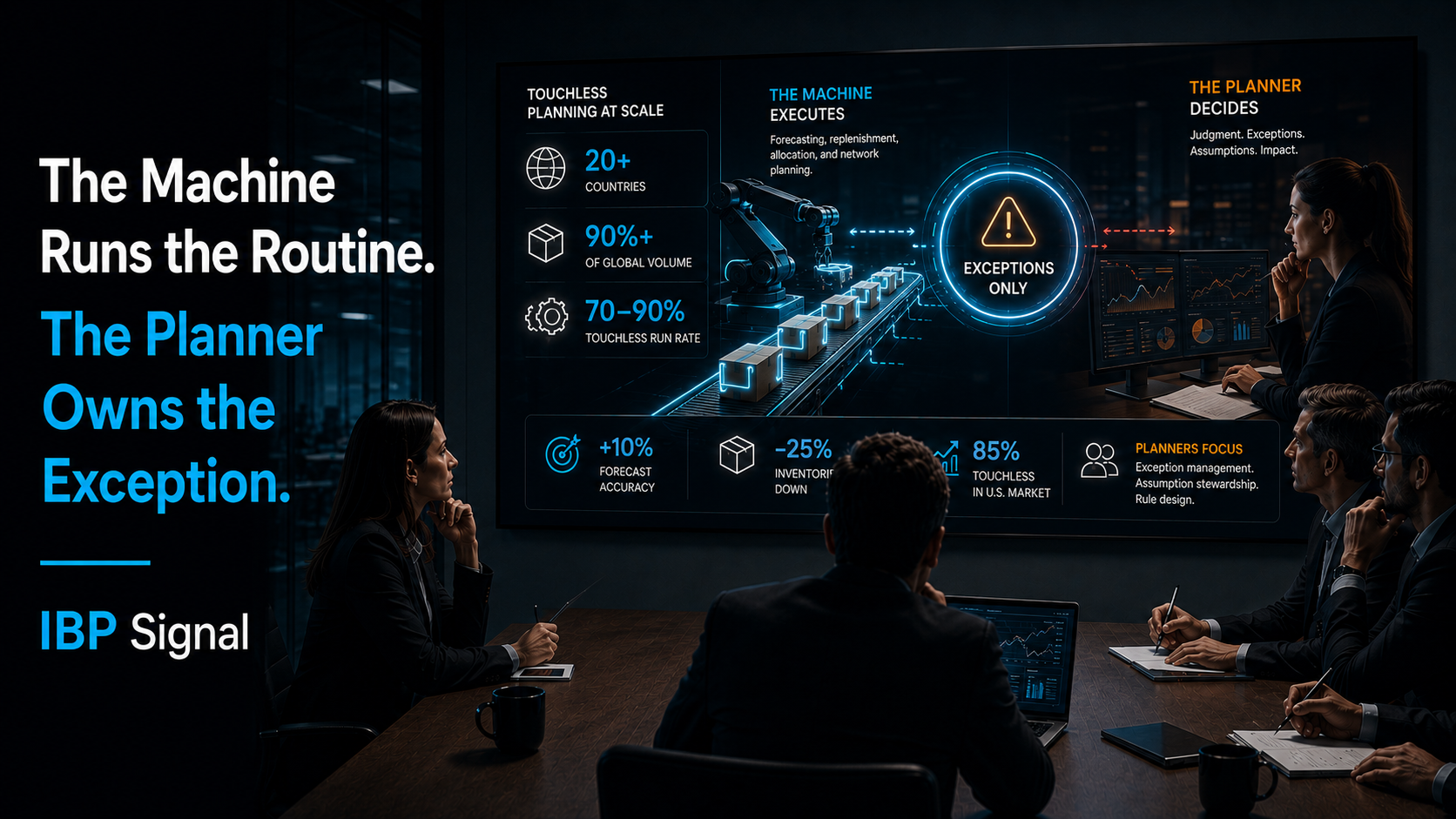
AB InBev's supply chain planning operation is now largely touchless across more than 20 countries, covering over 90% of global volume, according to o9 Solutions. Forecast accuracy improved by roughly 10%, inventories are down nearly 25%, and in several markets the supply network planning runs with 70% to 80%. In some cases, touchless rates reach 80% to 90%.
The most important detail is not in the percentages. It is in what AB InBev's planners are doing instead of clicking through spreadsheets.
Michael Kress, Global Vice President of Supply Chain Planning at AB InBev, describes the shift as a redefinition of the planner's role. The team has built what it calls a forecast value-add toolkit: a measurement framework that evaluates whether a planner's manual override actually improves the forecast or simply introduces noise. The framework helps identify which interventions add value and which merely introduce noise. The evidence here is not about eliminating planners. It is about changing where their value sits: judgment, not data entry.
Pattern Detected: Touchless Planning Redefines the Planner, Not Eliminates Them
This is the distinction that separates touchless planning from autopilot. AB InBev did not remove planners from the process. It removed the process work from the planners. What remains is exception management, assumption stewardship, and the design of the very rules that decide when the machine should act alone and when a human must intervene.
The scale is worth noting. Earlier o9 case studies from 2025 described AB InBev's deployment at 10 nations and 75% of global volume, a significant expansion in under a year. In the U.S. market, the company reports 85% touchless demand planning. The growth trajectory suggests this is not a pilot. It is an operating model.
Tool Check: What Gets Measured When the Machine Does the Work
Most IBP teams measure planner productivity in hours spent: reconciling forecasts, adjusting safety stocks, resolving supply exceptions. That metric becomes obsolete when the system executes most of those tasks automatically. The new metric is not activity; it is decision quality.
The forecast value-add toolkit is one way to measure that quality. But there is a deeper risk. When a planner manually adjusts a forecast, the assumption is usually visible: "Sales says the promotion will outperform baseline." As more routine planning is executed touchlessly, those assumptions are buried in model parameters and business rules. They are no longer reviewed in weekly meetings. They become invisible until one of them fails.
The planning gap is this: organizations adopting touchless planning are often still evaluating their planners on throughput and forecast ownership, even as the machine absorbs both. Without a redefined job description, planners either resist the system (because it removes their traditional value signal) or become passive observers (because they no longer know what they are accountable for).
The structural problem is that touchless planning changes the risk profile of the planning function. As more routine planning is executed touchlessly, the exceptions that still require human judgment become disproportionately consequential and disproportionately exposed. A bad override is no longer a minor forecast tweak. It is a high-stakes exception that the system has already flagged as non-routine.
The cost of inaction is a planning team that owns the process in name only: technically touchless, but without the exception judgment, assumption documentation, or process design discipline to make the remaining human decisions reliable.
Operating Context: Heineken's Parallel Track
Heineken offers a useful comparison point. The Dutch brewer has pursued a similar global S&OP and Digital Backbone program across more than 40 operating companies. The operating-model question is the same: once the machine handles the routine, what must the organization still own?
AB InBev's answer, backed by vendor-reported metrics and executive commentary, is clear: judgment, exceptions, and the logic of when to trust the machine.
Question Worth Asking
Of the planning decisions your system auto-executes today, which exceptions would you want a human to review, and do you have a written rule that tells that human what to look for?
If you cannot answer both, your touchless planning is missing its most important component.
Your Cycle This Week
Understand: Touchless planning raises the quality bar for the decisions that still require a human.
Ask: "Of the planning decisions our system auto-executes today, which exceptions would we want a human to review, and do we have a written rule that tells that human what to look for?"
Do: Audit your last ten planner overrides. For each one, note whether it improved the outcome, made it worse, or was unmeasurable. Then pick one auto-executed planning model and draft a one-page assumption registry that documents the key business rules it relies on.
IBP Signal is a weekly decision briefing for IBP, S&OP, and supply chain planning leaders. If this was useful, forward it to one planning leader who owns the cycle, not just the dashboard.
Sources
- o9 Solutions, "How AB InBev Is Building a Touchless Planning Organization," May 28, 2026.
- o9 Solutions, "Featured Value Creation Case Study: AB InBev's Planning Transformation Journey with o9," August 21, 2025; updated May 28, 2026.
- Consumer Goods Technology, "Why AB InBev's Supply Chain Overhaul Is Focused on Touchless Planning."
- SupplyChainBrain / Sunstice: Heineken global S&OP case study.